
How Many Pages Should a Chapter Be? What Nonfiction Actually Does
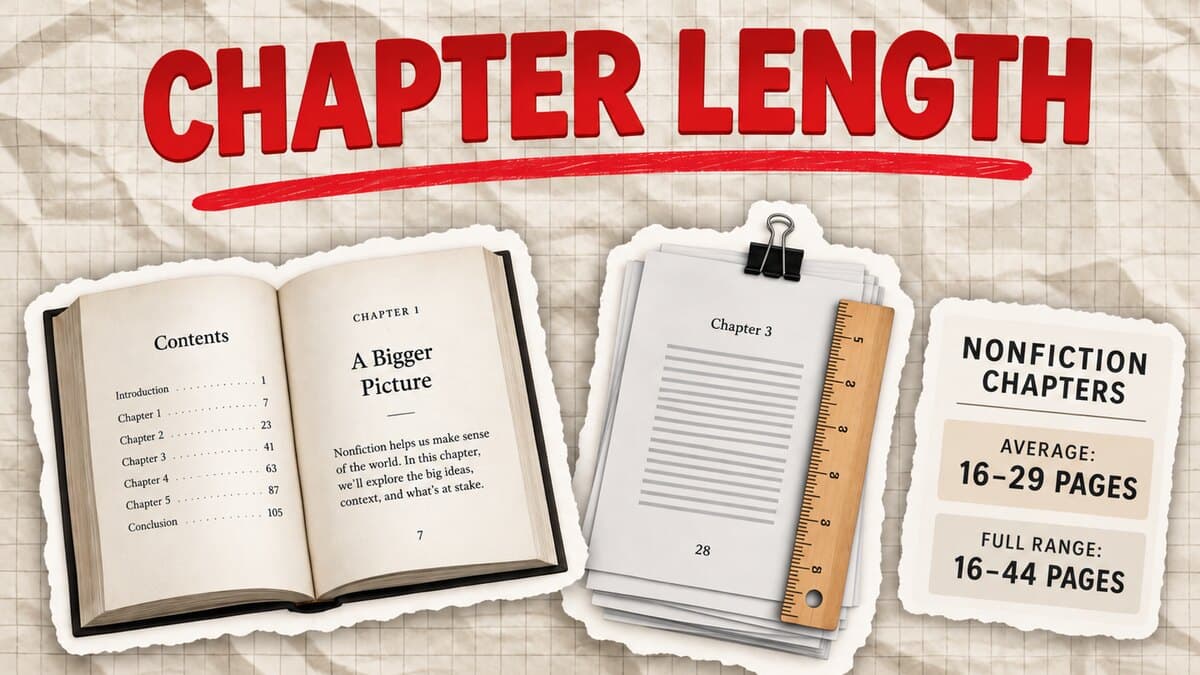
Commercial nonfiction chapters run 16 to 29 printed pages on average. A direct count of seven bestselling business books puts the full range at 16 to 44 pages. Consistency across a single book's chapters matters more than matching any outside target.
Key takeaways
- Seven bestselling nonfiction business books average 16 to 29 printed pages per chapter. Full range: 16 to 44 pages.
- Words per page depends on trim size and font, not writing style. A 4,000-word chapter runs about 14 pages at 6"x9" and about 10 pages at 5.5"x8.5".
- A miscalculated page count throws off spine width and is a common reason Amazon KDP rejects a cover file at upload.
- Built&Written's AI assistant, Wren, splits source material into chapters by topic, not by a fixed word count, and exports files ready for KDP.
About Built&Written: Built&Written helps founders and entrepreneurs turn raw drafts, transcripts, and notes into a structured manuscript with Wren, its AI writing assistant. Wren splits your material into chapters by topic, not by a fixed word count, and exports files ready for Amazon KDP self-publishing. See current plans for pricing.
1. What 7 Bestselling Business Books Actually Do
Writing advice often recommends 3,000 words a chapter without checking it against real books. We counted instead: total page count for each book's published edition, divided by its number of numbered chapters, excluding introductions, epilogues, and appendices.
Clear and Thiel write short, single-idea chapters that run 16 pages each. Collins writes long, case-study-driven chapters that run nearly three times that length. Chapter length follows the material, not a fixed rule.
The real range for commercial nonfiction is 16 to 29 pages per chapter. A draft far outside that range is worth a structural check before you publish it.
| Book | Pages (this edition) | Chapters | Pages per chapter |
| Atomic Habits, James Clear | 320 | 20 | 16 |
| Zero to One, Peter Thiel | 224 | 14 | 16 |
| Start with Why, Simon Sinek | 256 | 14 | 18 |
| Extreme Ownership, Willink & Babin | 320 | 12 | 27 |
| The Lean Startup, Eric Ries | 336 | 12 | 28 |
| Never Split the Difference, Voss & Raz | 288 | 10 | 29 |
| Good to Great, Jim Collins | 400 | 9 | 44 |
2. Words Per Page: The Conversion Table by Trim Size
Page count and word count aren't the same number. Trim size and font size change the words-per-page figure by 30% or more.
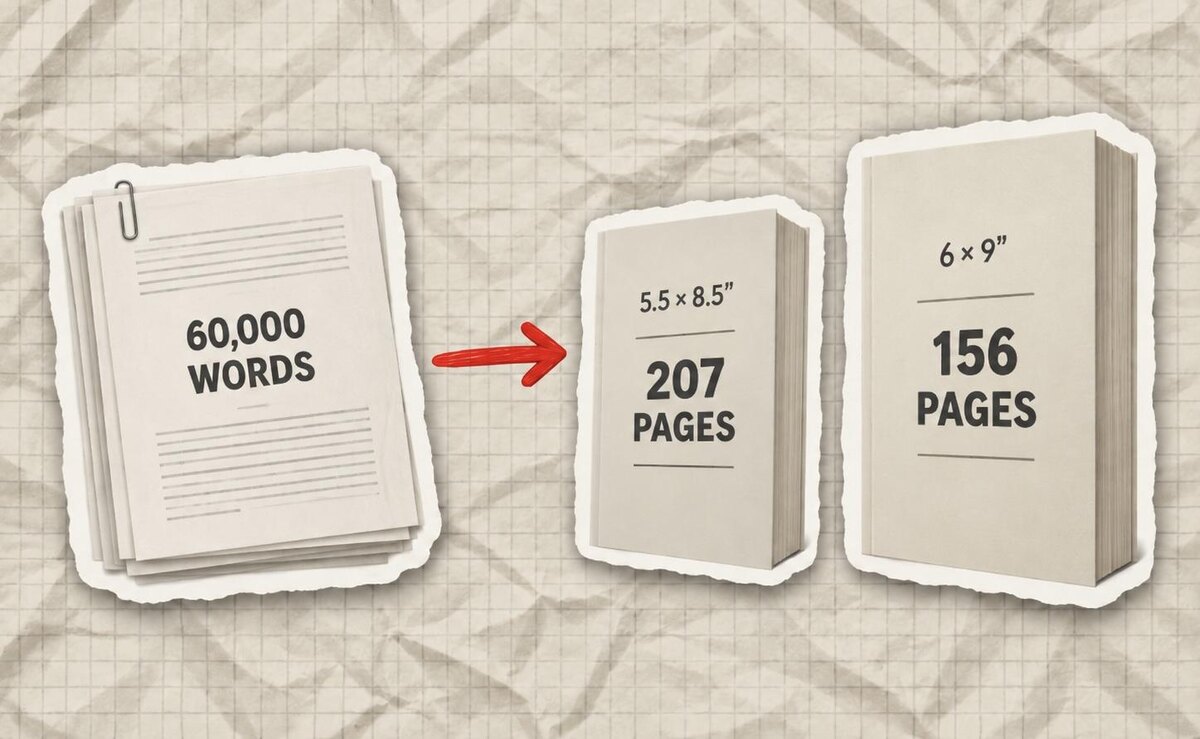
The common "250 to 300 words per page" figure is a manuscript-formatting standard (12pt, double-spaced), not a printed-book number. A 6"x9" nonfiction book, the standard trim for business titles, runs closer to 380 words a page. The same 60,000-word manuscript prints as a 156-page book at 6"x9" or a 207-page book at 5.5"x8.5".
Getting trim size and page count wrong has a direct cost on Amazon KDP. Spine width is calculated from final page count, and a mismatch between your file's actual page count and your declared trim size is one of the most common reasons KDP rejects a cover file at upload. Run the numbers with our own word count to page count calculator before you build the cover, confirm spine width with the spine width calculator, then check the finished file against KDP's own requirements with the KDP cover validator.
| Trim size | Font size | Approx. words per printed page |
| 5" x 8" | 11pt | ~290 |
| 5.5" x 8.5" | 11pt | ~290 |
| 6" x 9" | 11pt | ~384 |
| 8.5" x 11" (workbook) | 11pt | ~650 |
3. Why Consistency Across Chapters Beats Hitting a Magic Number
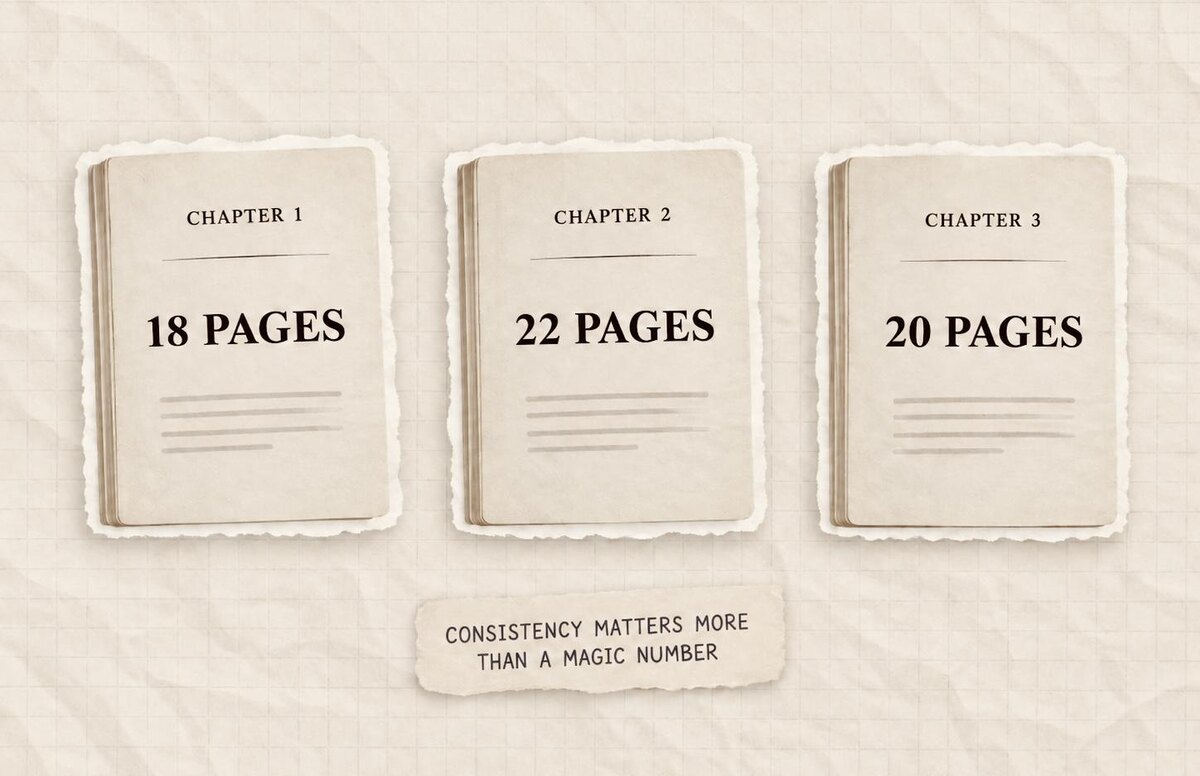
The seven-book count shows a pattern. Absolute chapter length varies widely between books, but each book holds a tight range around its own average. Atomic Habits runs 12 to 20 pages a chapter. Good to Great runs 35 to 50. Neither book mixes a 10-page chapter with a 60-page one.
Use this rule: a chapter within 20% of your book's average length is normal variation. A chapter running 2 to 3 times longer or shorter than your average needs a structural fix, not a content fix.
4. How to Restructure an Uneven Draft
Most first drafts don't have consistent chapters, because chapters get written in the order ideas arrive, not in the order that makes them even. Fix it in this order.
- Count. Get an exact word count per chapter before changing anything. A spreadsheet with one row per chapter and a word count column takes ten minutes.
- Split oversized chapters. A chapter running double your average is usually two ideas written as one. Split at the point the argument shifts, not at the halfway word count.
- Merge undersized chapters. A chapter running a third of your average, with too little material to justify its own heading, belongs inside a neighboring chapter.
- Fix the outline. Uneven chapter lengths are usually an outline problem. Our guide to nonfiction book structure covers three frameworks that keep chapters structurally comparable from the outline stage.
Tip: List your chapter titles with no other context. A title that reads like it belongs to a different book usually marks where the length problem started.
5. Skip the Manual Math: How Built&Written Handles Chapter Structure
Counting words per chapter by hand across a 50,000-word manuscript is manual work that doesn't move the book forward, and chapter length is only one piece of a manuscript's structure.
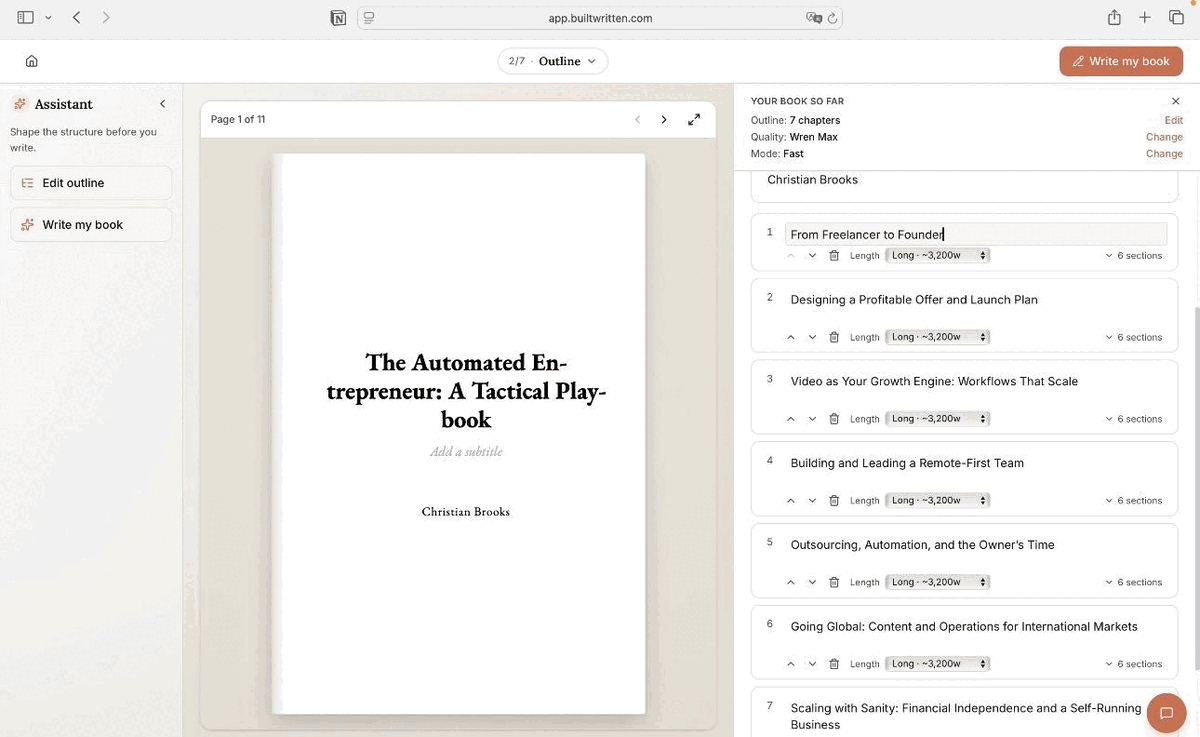
Built&Written is built to take a project from raw material to a finished, KDP-ready book without a spreadsheet in sight. Upload notes, transcripts, or an existing draft, and Wren runs the full structural pass at once, not just the chapter splits:
- Structure by topic, not template: Wren splits raw drafts, transcripts, and notes into chapters based on where the ideas divide, not a fixed word count.
- Voice-matched drafting: Wren writes in your voice using Voice DNA, so chapters stay consistent even when they're pulled from different sources.
- Front matter, generated with it: a title page, copyright page, and table of contents are built alongside your chapters, so structure isn't limited to the body of the book. Our guide to the parts of a book covers what each of those pages carries.
- KDP-ready export: finished manuscripts export as a print-ready PDF built for standard trim sizes like 6"x9", plus EPUB, fully formatted for Amazon KDP self-publishing requirements.
One pass, from scattered material to an upload-ready manuscript, with the page-count and trim-size math already done.
Chapter length is a range built from real books, not a fixed number. Check your draft against itself, not against someone else's average.
Final thoughts
There's no single correct chapter length. A 16-page chapter and a 44-page chapter can both be right. What matters is a consistent rhythm across your own book, and catching the one chapter that breaks it.
Frequently asked questions
How many pages is a chapter?
16 to 29 pages on average for commercial nonfiction, based on a direct count of seven bestselling business books. Full range: 16 to 44 pages.
How many words per page is a book?
About 380 words at 6"x9", about 290 at 5.5"x8.5" or 5"x8", and about 650 at 8.5"x11", all at 11pt. The "250 to 300 words a page" figure is a manuscript standard, not a printed-book number.
How long should a nonfiction chapter be in words?
3,000 to 7,000 words at standard trim sizes, matching the 16-to-44-page range found across the seven books counted for this piece.
Do all chapters in a book need to be the same length?
No. Keep each chapter within 20% of your book's average length. A chapter running 2 to 3 times longer or shorter usually needs to be split or merged.
Is a longer chapter better than a short one?
No. Zero to One runs 16 pages a chapter. Good to Great runs 44. Both are bestsellers. Match chapter length to the idea, not a target.
Frequently asked questions
16 to 29 pages on average for commercial nonfiction, based on a direct count of seven bestselling business books. Full range: 16 to 44 pages.
About 380 words at 6 by 9 inches, about 290 at 5.5 by 8.5 or 5 by 8, and about 650 at 8.5 by 11, all at 11pt. The 250 to 300 words a page figure is a manuscript standard, not a printed-book number.
3,000 to 7,000 words at standard trim sizes, matching the 16-to-44-page range found across the seven books counted for this piece.
No. Keep each chapter within 20% of your book's average length. A chapter running 2 to 3 times longer or shorter usually needs to be split or merged.
No. Zero to One runs 16 pages a chapter. Good to Great runs 44. Both are bestsellers. Match chapter length to the idea, not a target.
About the author

Khrystyna Balushka
More in Writing
Ready to write your book?
Turn your expertise into a professional book with Built&Written.