

Do You Have to Disclose AI in Your Book? KDP's 2026 Rules
In 2011, Walter Isaacson handed Steve Jobs a 600-page biography built almost entirely from someone else's words. Forty interviews with Jobs, hundreds more with the people around him, recordings transcribed and shaped into a narrative Jobs himself barely touched. Nobody called Steve Jobs fraudulent. Nobody demanded a disclosure on the cover saying "assembled from interviews." The book sold millions, and the authority transferred cleanly to the man on the jacket, because everyone understood the deal: the ideas were Jobs's, the assembly was Isaacson's, and that division of labor is how most authority books have always been made.
Every coach reading this in 2026 is sitting in a quieter version of that same chair. You have the ideas. You have a decade of LinkedIn posts, client frameworks, and voice memos that nobody has assembled into a book yet. The new assembler is AI, not a journalist. And the question that stops most coaches cold before they ever start is the one Isaacson never had to ask: do I have to tell Amazon? Do I have to tell my readers? Will the word "AI" anywhere near my book quietly torch the credibility I am writing it to build?
Short version: you are allowed to use AI, Amazon's rules are far narrower than the panic online suggests, and the disclosure (when it applies at all) is a checkbox between you and Amazon that your readers never see. The longer version is what this article is for, because the line Amazon actually draws is the single most misunderstood fact in self-publishing right now, and getting it right is the difference between publishing with confidence and not publishing at all.
We will work through this with a framework we call The AI Disclosure Decision: four components that take you from "am I going to get banned" to "here is exactly what I click, and here is why my book is still honestly mine." If you only remember one thing, remember that "AI-generated" and "AI-assisted" are two different categories in Amazon's eyes, and almost every coach writing an authority book lands in the safe one.
Key takeaway: No, you do not have to print an AI disclosure inside your book, and in most cases you do not have to disclose to Amazon at all. KDP requires you to disclose AI-generated text, images, or translations to Amazon via a checkbox in the publishing form. It does not require disclosure for AI-assisted content (where you created the content and AI helped refine it). The disclosure is private to Amazon. It never appears on your book's product page. AI-assisted books are allowed and unlabeled.
TL;DR: the AI disclosure rules for your book in 2026
| Question | The answer |
|---|---|
| Are AI books allowed on KDP? | Yes. AI-generated content is permitted. It must be disclosed to Amazon. |
| Do I disclose AI-assisted content? | No. If you created the content and AI refined it, no disclosure is required. |
| Where does the disclosure go? | A checkbox in the KDP publishing form. Private to Amazon only. |
| Does it show on my Amazon book page? | No. Readers never see it. There is no public "AI" badge as of 2026. |
| Does heavy editing change "generated" to "assisted"? | No. If AI produced the initial content, it stays "generated" even after edits. |
| Is an AI-assisted book legally mine? | Yes. You own a book you authored with AI assistance. Voice and ideas are yours. |
| Will readers reject it? | Most non-fiction readers do not, especially when your human voice is visible. |
The numbers and rules above come straight from Amazon's KDP Content Guidelines{target="_blank"}, cross-checked against the Authors Guild's analysis of the policy{target="_blank"}. They are current as of 2026. None of them ban you from publishing.
How we verified this: Every platform claim in this article is pulled from Amazon's own published KDP content guidelines and the AI-content section of its help center, not from a forum thread or a YouTube summary. Where we describe reader behavior, we cite peer-reviewed research and 2025 to 2026 survey data, and we report the actual finding even when it complicates the optimistic story. We do not quote a rule we could not find in Amazon's own words, and we flag the one place where the policy is genuinely a judgment call.
Why most coaches fail the AI Disclosure Decision before they start
The single most common reason a coach abandons a book is not writer's block. It is a rumor. Somewhere between a LinkedIn comment and a Reddit thread, the message lands that "Amazon bans AI books" or "you have to put a disclaimer in your book that says it was written by AI," and the project dies on contact. Both of those are wrong, and the cost of believing them is an entire credibility asset that never gets built.
The AI Disclosure Decision is the framework that replaces the rumor with the rule. It has four components. Each one answers a question that, left unanswered, becomes a reason not to publish.
Component 1: Generated vs. Assisted (the line Amazon actually draws)
This is the whole ballgame, and it is the part almost everyone gets wrong. Amazon does not have one bucket called "AI." It has two, and they are treated completely differently.
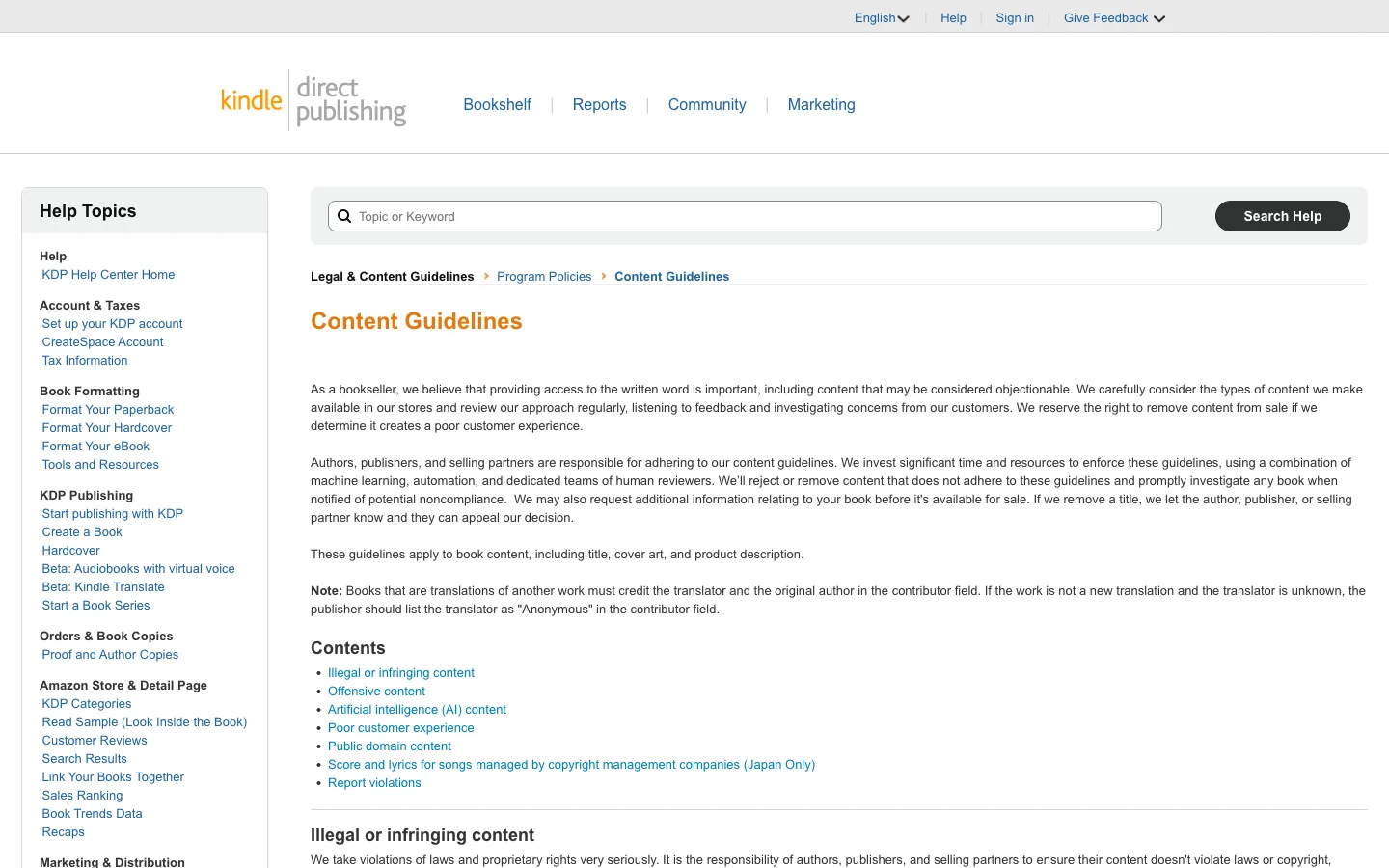
Amazon's definition{target="_blank"} of AI-generated content is text, images, or translations "created by an AI-based tool." Critically, the policy adds that if you used an AI tool to create the actual content, "it is considered 'AI-generated,' even if you applied substantial edits afterwards."
AI-assisted is the other bucket. Amazon defines it as content where "you created the content yourself, and used AI-based tools to edit, refine, error-check, or otherwise improve that content." It explicitly includes using AI to brainstorm and generate ideas, as long as you ultimately created the text yourself.
The dividing line is not how much AI touched the book. It is who produced the content that ended up on the page. If the words started as yours (your posts, your frameworks, your transcribed talks) and AI helped shape, structure, and polish them, that is assisted. If you typed a one-line prompt and the tool invented a book from nothing, that is generated. A coach assembling a book from a decade of their own writing is doing the first thing, not the second. We will come back to why that distinction matters so much for a tool like Built&Written{target="_blank"}.
Component 2: The KDP publishing-form answer (what you click and where it goes)
If your content does fall into the generated bucket, the disclosure is not a scarlet letter. It is a question in the KDP publishing workflow. When you set up or edit a title, KDP asks whether your book contains AI-generated content (text, images, or translations). You answer yes or no. That answer goes to Amazon and stops there.
The thing coaches fear most (a stamp on their book that says a machine wrote it) does not exist. We cover exactly where this question appears and how to answer it in our step-by-step guide to publishing on Amazon KDP, and the broader publishing path in the coach's guide to AI book writing and publishing.
Component 3: The reader-trust test (disclose to the reader or not?)
Amazon's rule is about Amazon. Your reader is a separate decision, and it is yours to make. There is no legal requirement to tell readers anything. The question becomes a positioning one: does a line in your introduction acknowledging AI assistance help or hurt? The honest answer, backed by research we will get into below, is "it depends on how the AI was used and how visible your own effort is." For an authority book assembled from your real material, the safest play is usually to let the work speak and not over-explain a tool you used the way an earlier author used a word processor.
Component 4: The authentic-voice safeguard (why Voice DNA keeps the book honestly yours)
The deepest fear under the disclosure question is not legal. It is identity. "If AI helped write it, is it even my book?" This is where the tooling actually matters. A book that sounds like a generic chatbot is the thing readers (and Amazon's quality enforcement) correctly distrust. A book that sounds like you, because it was built from your words and tuned to your voice, is yours in every way that counts. Built&Written's Voice DNA exists to keep the output on the right side of that line, and it is the reason an AI-assisted authority book can be both efficient and genuinely authored.
How does KDP's AI policy compare to a disclaimer, a copyright page, and what readers actually see?
This is the comparison that clears up most of the confusion, because coaches conflate four different things that have nothing to do with each other. Here is each one, side by side.
The KDP disclosure vs. an in-book disclaimer
The KDP disclosure is a private checkbox answered during publishing. An in-book disclaimer is text you choose to print on a page inside the book. Amazon requires the first one (only for AI-generated content) and requires nothing about the second. You are free to add a note in your acknowledgments if you want to. You are equally free not to. The two are unrelated, and confusing them is why people believe Amazon forces a disclaimer onto the page. It does not.
The KDP disclosure vs. the public product page
Here is the fact that calms most of the anxiety: the disclosure never reaches your readers. As the Authors Guild documented{target="_blank"}, Amazon's policy requires authors to share AI information with Amazon, "not with Kindle readers," and Amazon has not added any public badge such as "AI-generated" on product pages. Your book's Amazon listing in 2026 looks exactly like any other book's. No label, no asterisk, no warning. The disclosure is a back-office data point, not a customer-facing mark.
The KDP disclosure vs. copyright and ownership
Disclosure and ownership are completely separate questions. Telling Amazon you used AI does not give up any rights, and not telling them does not grant you any. Copyright for an AI-assisted book where you authored and arranged the content sits with you. We unpack the nuances of authorship and protection in our 4P playbook on copyright for self-published books, but the short version is that the checkbox is a compliance signal, not a transfer of ownership.
What happens if you disclose wrong, or not at all
Amazon's enforcement is real, and it tightened through 2025 and 2026. The consequence for skipping a required disclosure is removal of the title, and repeated violations can lead to account action. Amazon also caps self-publishing uploads at three titles per day, a limit it introduced{target="_blank"} specifically to slow the flood of low-quality AI-spam books. None of this targets a coach publishing one carefully assembled authority book. It targets volume farms uploading dozens of keyword-stuffed titles a day. The honest takeaway: disclose when the rule applies, do not over-disclose out of fear, and you will never trip the enforcement that exists for an entirely different kind of publisher.
Name the asymmetry and the panic falls apart. The enforcement machine Amazon built in 2025 and 2026 is a volume filter. It is designed to catch a publisher who uploads forty near-identical "books" about passive income in a single week, each one a thin AI dump with a stock cover. A coach who spends a month assembling one book from a decade of their own client work is the precise opposite of that profile, on every signal Amazon cares about: upload velocity, content originality, voice consistency, and account history. You are not the target, and behaving as if you are is what keeps a credibility asset trapped on your hard drive. The rational move is to treat the disclosure question the way you treat any other compliance checkbox: answer it honestly, once, and move on.
How this differs from the AI rules on other platforms
KDP is not the only place coaches publish, and the rules are not uniform across the industry, which adds to the confusion. Some platforms have stricter or looser stances, and a few are still writing their policies in real time. Amazon's "disclose generated, ignore assisted, keep it private" model is actually one of the more author-friendly frameworks out there, because it neither bans AI nor brands your book publicly. The Authors Guild, which pushed hard for the disclosure rule, called it a welcome first step{target="_blank"} precisely because it threads the needle between transparency and not punishing legitimate authors. If you later expand distribution beyond KDP, check each platform's terms, but for the Amazon-first path most coaches take, the rules in this article are the ones that govern.
What it does not do, stated plainly
To keep this honest: Built&Written does not upload to KDP for you (you export the package and upload it yourself), it does not pull from LinkedIn automatically (you paste your content), it does not transcribe podcasts (you paste the transcript), and it does not translate your book. Knowing the real boundaries matters, because a tool that over-promised would put your disclosure answer at risk. The point is a clean, honest assisted workflow, not a black box. For the publishing path itself, our self-publish a coaching book on Amazon KDP guide carries it the rest of the way.
From fear to published: the coach's AI disclosure checklist
Here is the whole decision compressed into a sequence you can actually run. Work through it in order and the disclosure question stops being a blocker.
Step 1: Confirm your content is yours
Before anything else, verify that the substance of the book starts with your material: your posts, frameworks, transcripts, notes. If the ideas and the raw text originate with you, you are building an AI-assisted book, and most of the disclosure anxiety evaporates here.
Step 2: Use AI to assemble and refine, not to invent
Feed the tool your content and your voice samples. Let it structure, draft, and polish. Keep yourself in the author's chair by reviewing and rewriting. This is the behavior that matches Amazon's AI-assisted definition{target="_blank"} word for word.
Step 3: Make the generated-vs-assisted call honestly
Look at your finished book and answer the real question: did AI produce content that appears in the final book, or did you produce it with AI's help? If any chapters, images, or translations were created by AI from scratch, that part is generated and you disclose. If it is all your refined material, you do not. When genuinely unsure, the safe and simple move is to disclose. Disclosure costs you nothing visible.
Step 4: Answer the KDP form, then forget about it
In the publishing workflow, answer the AI-generated content question truthfully. That is the entire obligation. It goes to Amazon, never to your readers. Our KDP no-fluff guide for experts covers the rest of the form.
Step 5: Decide your reader stance with confidence, not fear
Choose deliberately whether to acknowledge AI to readers. For an authority book in your voice, letting the work stand is usually right. If you disclose, keep it to one line. Either way, make sure your human agency is visible in the actual content, because that, not the disclaimer, is what protects your credibility.
Try Built&Written free. Assemble your existing content into a KDP-ready book in your own voice, then answer the disclosure question with a clear conscience. Put your book on the page →{target="_blank"}
The verdict: do you have to disclose AI in your book?
You do not have to disclose AI inside your book to anyone, ever. There is no Amazon rule, no legal rule, and no industry rule that forces a disclaimer onto your pages or a badge onto your product listing.
You may have to disclose to Amazon, privately, via a checkbox, and only if your book contains AI-generated content (text, images, or translations the AI created from scratch). If your book is AI-assisted, built from your own material and refined with AI, you owe Amazon nothing on this front. The line is who produced the content, not how much AI touched it.
For the coach, consultant, or founder this article is written for, the practical verdict is liberating: an authority book assembled from your own writing, tuned to your own voice, and reviewed by you is an AI-assisted book in Amazon's eyes. It is allowed. It is unlabeled. It is yours. The fear that kept the project on the shelf was built on a rumor about a different kind of book. Walter Isaacson did not need a disclaimer to assemble Steve Jobs's authority into a book the world trusted. Neither do you.
Key takeaways
The AI Disclosure Decision, one more time, so it sticks.
- Generated vs. Assisted is the only line that matters. AI-generated means the AI created the content. AI-assisted means you created it and AI refined it. Coaches assembling a book from their own material are almost always in the assisted bucket. Amazon's own definition{target="_blank"} confirms it.
- The disclosure is a private checkbox, not a label. When it applies, you answer one question in the KDP publishing form. It goes to Amazon. It never appears in your book or on your product page.
- AI-assisted books require no disclosure at all. Build from your content, refine with AI, and you owe Amazon nothing on this question.
- Reader trust comes from visible human effort, not from hiding. The transparency-penalty research is clear: a book that shows your voice and agency is the most defensible position. If you disclose to readers, one line beats a paragraph.
- The right tool keeps you on the safe side by design. Built&Written's{target="_blank"} assemble-from-your-content model and Voice DNA produce an AI-assisted book with your authorship baked in. Free tier plus paid plans.
FAQ
Will Amazon ban my book if it's AI-written?
No. AI-generated content is explicitly allowed on Amazon KDP. The only requirement is that you disclose AI-generated text, images, or translations to Amazon via a checkbox in the publishing form. Amazon removes titles for undisclosed AI-generated content, not for AI use itself. An AI-assisted book built from your own material requires no disclosure and faces no penalty. Enforcement targets high-volume spam farms, not coaches publishing a single authored book.
Does the AI disclosure show on my book's Amazon page?
No. The disclosure is private between you and Amazon. As the Authors Guild has documented, Amazon's policy requires authors to inform Amazon, not Kindle readers, and Amazon has not added any public "AI-generated" badge to product pages as of 2026. Your listing looks identical to every other book's. There is no label, asterisk, or warning visible to customers.
Is an AI-assisted book still legally mine?
Yes. When you author and arrange the content and use AI to refine it, the book is yours. Copyright protection for the human-authored selection, arrangement, and expression sits with you. Disclosing AI use to Amazon does not surrender any rights, and the ideas, frameworks, and voice in an authority book assembled from your own material are yours throughout. See our copyright playbook for self-published books for the nuances.
Do I have to disclose AI if I heavily edited it?
This is the one genuine judgment call. Amazon's policy states that if an AI tool created the actual content, it stays "AI-generated" even after substantial edits. Editing AI-generated text does not convert it to AI-assisted. However, if you created the content yourself and used AI to refine your writing, that is AI-assisted from the start and needs no disclosure. The test is the origin of the content, not the amount of editing. When unsure, disclose. It costs you nothing visible.
Will readers trust an AI-assisted book?
Mostly yes, especially in non-fiction. Reader research from 2025 and 2026 shows a clear majority will read an AI-assisted book if the content is good, with non-fiction readers the most accepting. Research did find a transparency penalty where disclosure can lower trust, but the penalty shrinks when human effort is visible in the work. A book in your real voice, with your stories and frameworks, is the most trusted version. This is exactly what Voice DNA protects.
Do I have to tell Amazon my book is AI if I only used it to brainstorm or edit?
No. Amazon explicitly classifies brainstorming, idea generation, editing, refining, and error-checking as AI-assisted, which requires no disclosure. Using AI like a smart editor or thinking partner while you create the content yourself is not a disclosable event. The disclosure requirement only applies when the AI produced content that appears in the final book.
What's the difference between AI-generated and AI-assisted on KDP?
AI-generated means an AI tool created the text, images, or translations that appear in your book, even if you edited them afterward. AI-assisted means you created the content yourself and used AI to refine, edit, or improve it, including brainstorming ideas. Only AI-generated content must be disclosed to Amazon. AI-assisted content does not. The full definitions are in Amazon's KDP Content Guidelines{target="_blank"}.
Can a ghostwritten book skip disclosure when an AI tool is involved?
The rule follows the content, not the label on the service. If a human ghostwriter or a tool produces content the AI generated from scratch, that is disclosable AI-generated content. If you supplied the material and AI assisted in shaping it, it is AI-assisted. The fact that a process is called "ghostwriting" does not change Amazon's test. For how AI compares to traditional ghostwriting, see what ghostwriting is in 2026.
Sources & References
- Amazon KDP Content Guidelines (AI content definitions and disclosure policy){target="_blank"}
- Amazon Kindle Direct Publishing help center{target="_blank"}
- Authors Guild: Amazon's New Disclosure Policy for AI-Generated Book Content Is a Welcome First Step{target="_blank"}
- Authors Guild: Amazon Adds to KDP Generative AI Policy, Caps Daily Self-Publishing Uploads{target="_blank"}
- Understanding Reader Perception Shifts upon Disclosure of AI Authorship (arXiv preprint, 2025){target="_blank"}
- Full Disclosure, Less Trust? How the Level of Detail about AI Use Affects Readers' Trust (arXiv, 2026){target="_blank"}
- International Coaching Federation{target="_blank"}
- Built&Written{target="_blank"}
- Built&Written editor (free tier){target="_blank"}
Frequently asked questions
No. AI-generated content is explicitly allowed on Amazon KDP. The only requirement is that you disclose AI-generated text, images, or translations to Amazon via a checkbox in the publishing form. Amazon removes titles for undisclosed AI-generated content, not for AI use itself. An AI-assisted book built from your own material requires no disclosure and faces no penalty. Enforcement targets high-volume spam farms, not coaches publishing a single authored book.
No. The disclosure is private between you and Amazon. As the Authors Guild has documented, Amazon's policy requires authors to inform Amazon, not Kindle readers, and Amazon has not added any public AI-generated badge to product pages as of 2026. Your listing looks identical to every other book's. There is no label, asterisk, or warning visible to customers.
Yes. When you author and arrange the content and use AI to refine it, the book is yours. Copyright protection for the human-authored selection, arrangement, and expression sits with you. Disclosing AI use to Amazon does not surrender any rights, and the ideas, frameworks, and voice in an authority book assembled from your own material are yours throughout.
This is the one genuine judgment call. Amazon's policy states that if an AI tool created the actual content, it stays AI-generated even after substantial edits. Editing AI-generated text does not convert it to AI-assisted. However, if you created the content yourself and used AI to refine your writing, that is AI-assisted from the start and needs no disclosure. The test is the origin of the content, not the amount of editing. When unsure, disclose. It costs you nothing visible.
Mostly yes, especially in non-fiction. Reader research from 2025 and 2026 shows a clear majority will read an AI-assisted book if the content is good, with non-fiction readers the most accepting. Research did find a transparency penalty where disclosure can lower trust, but the penalty shrinks when human effort is visible in the work. A book in your real voice, with your stories and frameworks, is the most trusted version.
No. Amazon explicitly classifies brainstorming, idea generation, editing, refining, and error-checking as AI-assisted, which requires no disclosure. Using AI like a smart editor or thinking partner while you create the content yourself is not a disclosable event. The disclosure requirement only applies when the AI produced content that appears in the final book.
AI-generated means an AI tool created the text, images, or translations that appear in your book, even if you edited them afterward. AI-assisted means you created the content yourself and used AI to refine, edit, or improve it, including brainstorming ideas. Only AI-generated content must be disclosed to Amazon. AI-assisted content does not.
The rule follows the content, not the label on the service. If a human ghostwriter or a tool produces content the AI generated from scratch, that is disclosable AI-generated content. If you supplied the material and AI assisted in shaping it, it is AI-assisted. The fact that a process is called ghostwriting does not change Amazon's test.
Sources & References
- https://kdp.amazon.com/en_US/help/topic/G200672390
- https://kdp.amazon.com/en_US/help
- https://authorsguild.org/news/amazons-new-disclosure-policy-for-ai-generated-book-content-is-a-welcome-first-step/
- https://authorsguild.org/news/amazon-adds-to-kdp-generative-ai-policy-caps-daily-self-publishing-uploads/
- https://arxiv.org/abs/2510.24011
- https://arxiv.org/pdf/2601.09620
- https://coachingfederation.org/
- https://www.builtwritten.com/
- https://www.builtwritten.com/editor
About the author

Mykhailo Druz
More in informational
Ready to write your book?
Turn your expertise into a professional book with Built&Written.